


Starlink is booming
Starlink has become one of SpaceX’s most lucrative units, and that’s bad news for the telecom and cable industry.While market share stats and subscriber numbers may not indicate that yet, the recent duress on shares of Comcast, Charter, AT&T, and Verizon tell a different story, per Barron’s.
Starlink now boasts 12 million subscribers globally, with the US user base making up a quarter of that figure.
Wolfe Research analyst Peter Supino views the company as a serious threat to established players.
For years, Starlink has been understood by Wall Street as a rural broadband solution, and unknown to most consumers. No longer—Starlink’s advances in satellite technology and launch capacity have accelerated capacity growth and marketing investments.
Peter Supino, Wolfe Research analyst, June 2026
Not a rural-only option
Starlink was once seen as a last resort for rural audiences with no other options. But as the tech improves, the user base is exploding, with the company routinely doubling its subscriber count year-over-year.
T-Mobile even lost American Airlines and United Airlines to it for in-flight Wi-Fi.
Oppenheimer analyst Tim Horan expects SpaceX to disrupt the communications industry, noting that communications could become its first major commercial business.
SpaceX CEO Elon Musk hasn’t shied away from asserting confidence in the company’s ability to eventually surpass traditional internet and wireless companies. Starlink’s satellites cover a large area, so the cost of adding new households is incredibly low compared to legacy internet companies that have to lay down physical infrastructure first.
Horan expects Starlink to hit 15 million US customers by 2030, a massive leap over the current 3 million.
Getting better
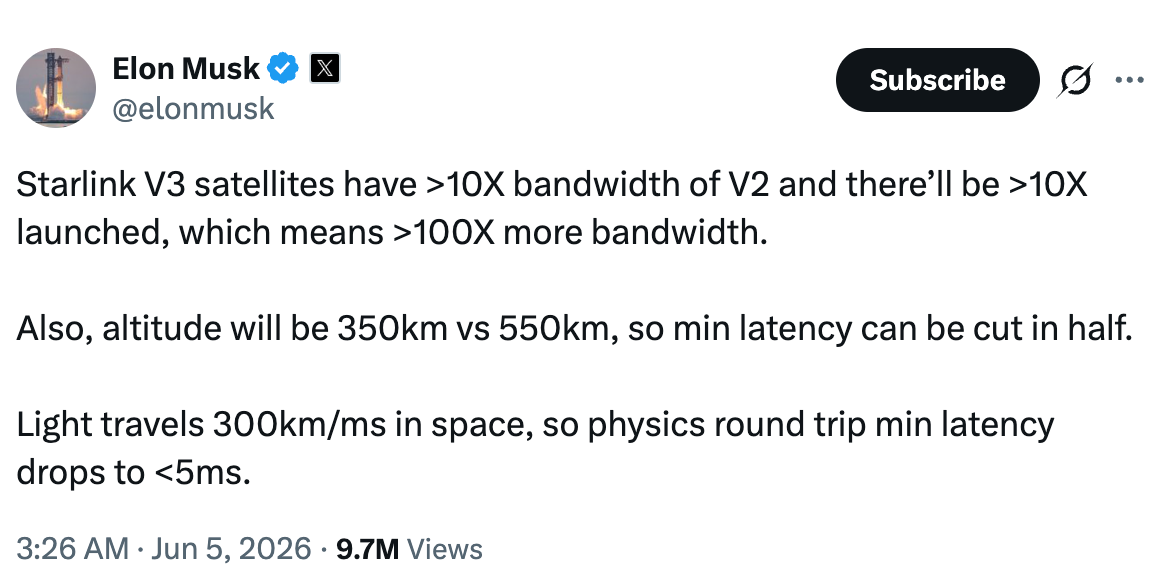
Next-gen Starlink satellites will be more capable than the current V2 satellites. | Image by Elon Musk
SpaceX is gearing up to deploy next-generation Starlink broadband V3 satellites in the second half of 2026. They will have a downlink capacity of 1 Tbps per satellite.
For reference, a typical home connection offers speeds between 100 Mbps and 1 Gbps.
Not only will the new satellites have more capacity, but SpaceX also plans to launch them at ten times the current rate. On top of that, the orbital altitude will drop from 550km to 350km, cutting latency, or delays, in half. Musk says to expect latency of under 5 ms, easily rivaling fiber and beating cable.
Carriers and wireless players should be worried
Cable companies are currently most at risk due to their heavy dependence on broadband for profits and older tech. Established fiber players such as AT&T and Verizon will feel the squeeze down the road. T-Mobile is relatively safe for now since its fiber business isn’t massive enough to begin with. However, the company has been on an acquisition spree, meaning SpaceX will eventually come for its lunch, too.
#SpaceX #coming #ATT #Verizon #TMobile