


How the Supreme Court ruled
The 8-1 ruling keeps the FCC’s power to fine carriers intact. | Image by Library of Congress
Chief Justice John Roberts wrote for the majority, with Justice Clarence Thomas as the only dissenter. The carriers had argued that the FCC violated their Seventh Amendment right to a jury trial by issuing the fines through its own in-house process instead of going to court.
The court disagreed, and the reasoning matters. Roberts pointed out that a carrier can simply refuse to pay, which forces the Justice Department to file a lawsuit within five years. That lawsuit would come with the jury trial the carriers wanted, so the FCC’s fines do not strip anyone of their constitutional rights.
What actually happened to your data
The case traces back to a Mississippi sheriff who used a service called Securus to track people’s phones without a court order. The FCC’s investigation found that AT&T, Sprint, T-Mobile, and Verizon had all sold access to customer location information to data brokers, who passed it along to outside parties.The carriers were supposed to protect that information under the 1996 Telecommunications Act. They did not do enough to stop the misuse, and the fines followed.
Why is it important
This is a privacy win, and it is one our readers asked for. When we asked where you stood ahead of the decision, about 70 percent of voters wanted the Supreme Court to side with the FCC, with fewer than 10 percent backing the carriers. The court delivered exactly the outcome the majority of you were hoping for.Not everyone is celebrating, though. Over on the r/scotus subreddit, one commenter sided with Thomas, arguing it was never clear the carriers could ignore the fines and that taking their money before telling them they could have fought it in court is not fair. The take was downvoted to the bottom of the thread, which tells you where the room landed, but it reflects the one real sticking point in the case.
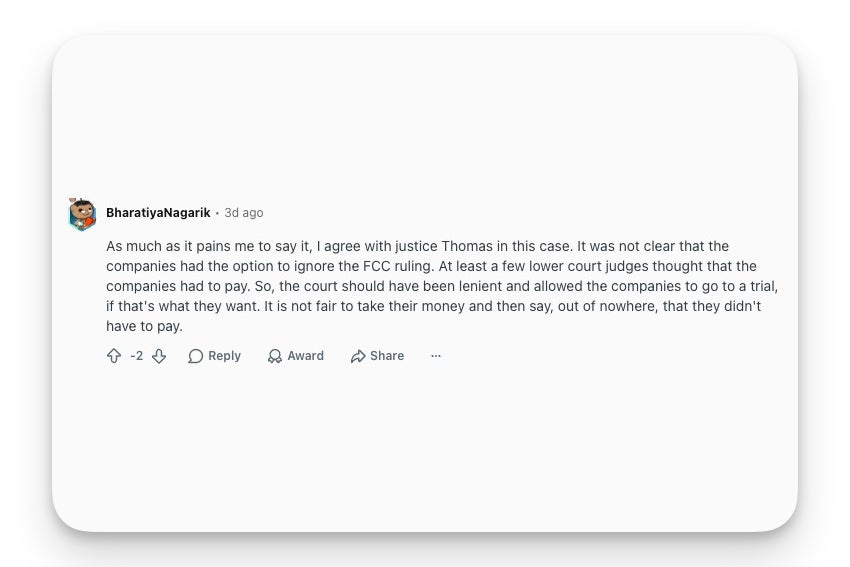
Not everyone agreed with the ruling, though this take landed at the bottom of the thread. | Image by BharatiyaNagarik via Reddit
That sticking point is Thomas’s dissent. He agreed with the process going forward but argued that when AT&T and Verizon paid up, no carrier had ever gotten a jury trial in this kind of FCC action, so they had no way of knowing the option existed. For everyday phone users, the practical result is the same either way: the FCC keeps the power to police how carriers handle your location data, and that power just got a lot harder to challenge.
What this means if you are on T-Mobile
The court only ruled on AT&T and Verizon, but T-Mobile should not feel safe. T-Mobile and Sprint were hit with a combined fine of about $92 million in the same FCC action, and the legal logic the court just blessed applies to their challenge too. If you are a T-Mobile customer, this ruling effectively closes the same escape route your carrier was counting on.The bigger pattern is the one worth sitting with. Carriers sold your location data, got caught, fought the penalty for years, and only now have run out of road. By the time accountability arrives, it usually shows up as a fine the company can absorb or a class action that pays customers pennies, while the data is long gone. The ruling is a win, but it is a reminder of how slow the system moves when your privacy is the thing on the line.
#ATT #Verizon #TMobile #sold #location #data #Supreme #Court #ruled