



Ethics guidelines for clinical trials already exist. But BCI trials are different, says Jennifer Chandler, a professor of law and neuroethics at the University of Ottawa who also worked on the guidelines. “These are people who have a device embedded in their brain, are in trials sometimes for years and years … [and contribute] a significant investment of time, of the body, and of intellectual effort.”
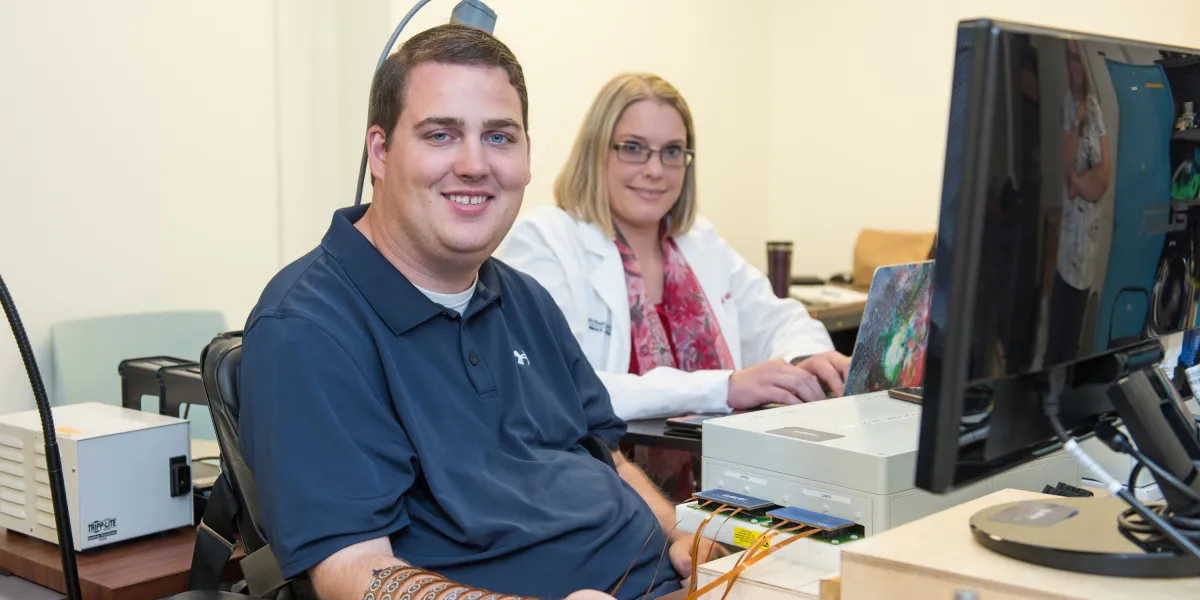
Burkhart was left paralyzed from the chest down following a diving accident in 2010, when he was 19 years old. Around four years later, he volunteered to become the first person to trial a brain implant designed for hand control.
He had an array of 96 electrodes inserted into the part of his brain that controls movement. The electrodes were connected to a computer via a cable that essentially plugged into his head. Algorithms on the computer were designed to interpret those signals and deliver them to another sleeve of electrodes worn on Burkhart’s arm, allowing him to control it.
The first movements were small, but Burkhart was ultimately able to use the system to pour beads from bottles, move small and delicate objects, and even play Guitar Hero, if only during lab visits. It was a scientific breakthrough.
Burkhart took part in two years-long clinical trials over the seven-and-a-half-year period he had the electrode array implanted in his brain. “It was a fantastic experience,” he says. “But there’s certainly some things that, knowing what I know now, I would want to do a little differently.”
#autonomy #NDAs #Volunteers #requests #brain #implant #trials