


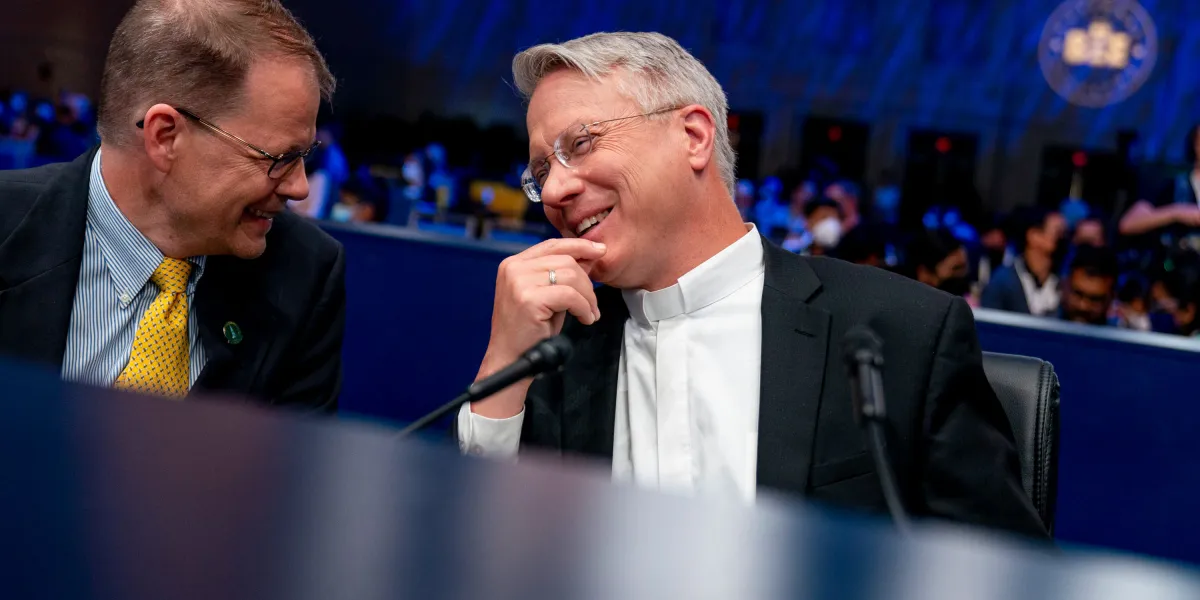

AP PHOTO/CAROLYN KASTER
At the Greek Orthodox church in Springfield, Sietsema’s facility for languages proved useful when he served as a volunteer chanter, helping the priest lead services in Greek. “I do a good job with the liturgical Greek because I have the phonological knowledge to know how to make my mouth do the things that it needs to do to sound like authentic Greek speech as opposed to an American just rattling off Greek letters,” he says.
He began taking evening classes in Byzantine chant, and before long the bishop was encouraging him to attend seminary. Merriam-Webster allowed him to work four 10-hour days so he could commute to Brookline to study at the Holy Cross Greek Orthodox School of Theology. And after four years, he earned a master of divinity degree.
Sietsema fully intended to go back to being a lexicographer, perhaps eventually getting ordained so he could serve as a substitute priest on weekends. But he’d made what he jokingly calls “a terrible mistake” at the seminary: He’d embraced his studies so enthusiastically that he became the valedictorian and had to give the commencement speech. The archbishop of America—the head of the Greek Orthodox church in the US—came up from New York to attend the ceremony, and he happened to be in need of a deacon who could also serve as a speechwriter. “A few weeks later, I got a call from the archdiocese saying ‘We want you to be ordained, and we want you to come to New York, and we want you to write for the archbishop,’” Sietsema recalls.
In short order, he and his wife moved to the Upper East Side of Manhattan so he could begin his new post as Father Mark (he used his middle name because Orthodox priests must be ordained with a saint’s name, and there are no Orthodox Saint Brians). As deacon to the archbishop and then to his successor, he wrote their speeches and encyclicals on top of many other duties—including chauffeuring them through New York City traffic—and traveled with them around the country and to Greece, meeting President Clinton, ambassadors, members of Congress, Elie Wiesel, and South Africa’s Anglican Archbishop Desmond Tutu along the way. But after two years, as the father of a newborn, he was eager to move on from a job that required putting in as many as 14 hours six or seven days a week. So in 2000, he returned to Michigan to become pastor of the Holy Trinity Greek Orthodox Church in Lansing.
“The World Series can be a four-game sweep and the Super Bowl can be a blowout, but the National Spelling Bee always comes down to one last word.”
Not long after settling into parish life, Sietsema got an unexpected call from the Scripps Spelling Bee. His wife had served on the event’s word panel from 1997 to 2000, and he had traveled with her to one of the members’ off-site gatherings in 1998. He’d tagged along to dinner one night, and they were pleased to meet the person who was responsible for pronunciations in the bee’s official dictionary. But now, just a few weeks before the 2003 event, there was a crisis: The longtime pronouncer had suddenly died. The veteran associate pronouncer would step into his role and take on the job of giving spellers their words, but a new associate pronouncer would be needed to answer spellers’ questions about word roots, monitor pronunciations, and be prepared to serve as the pronouncer if needed. Could he do it? Honored to be asked, Sietsema got the okay from his bishop and said yes.
Little did he know it would become a permanent gig. After 15 years of answering root-word queries, when the bee expanded in 2018 he began serving as a pronouncer for some of the earlier rounds as well—though never for the finals. Now he’s the head of a team of associate pronouncers. “It’s just wonderful to see these young people blossom right in front of you, asking their questions and analyzing the word on the spot and figuring out how it all goes together,” he says. He dismisses the idea that the kids have photographic memories, saying they’re “really just good little word detectives.”
As a member of the bee’s word panel, Sietsema attends multiple daylong meetings to create and fine-tune each year’s list by mining the 500,000 or so words in Merriam-Webster’s unabridged dictionary. “For an introductory round, you want something that’s an interesting word, a useful word, but something that’s gettable,” he says. “For the later rounds, you really want to find something that’s going to challenge the speller. And it’s nice to have a word that’s analyzable.” “Rooty” words—those with obvious roots—are ideal.
The advent of unabridged online dictionaries has streamlined how students prepare for the bee, which once required wading through the dictionary manually to compile word lists. Today, it’s easy to generate lists of words derived from a particular language to study their roots, for example. Meanwhile, the competition has become increasingly fierce, and once-verboten terms like geographical names are considered fair game. For some of the words in the hardest rounds, “it looks like you’re just taking a spoonful of alphabet soup,” he says. “And that’s for the spellers who really, really are committed to learning just about every word they can in the dictionary.”
#man #words